Introduction
The modern office is no longer just a workplace — it is a dynamic environment designed to foster productivity, collaboration, innovation, and employee well-being. With hybrid work models, rapid digital transformation, and shifting workforce expectations, organizations are reimagining office spaces to be more flexible, sustainable, and technology-driven.
To meet these demands, architects, PMC’s, corporate leaders, and interior designers are increasingly investing in modern, adaptable workspace solutions. At the forefront of this transformation is modular office furniture — enabling scalable, ergonomic, and future-ready office environments.
As we move into 2026, modular solutions are redefining workspace strategy. This blog explores the Top Modular Office Furniture Trends 2026 shaping next-generation offices.
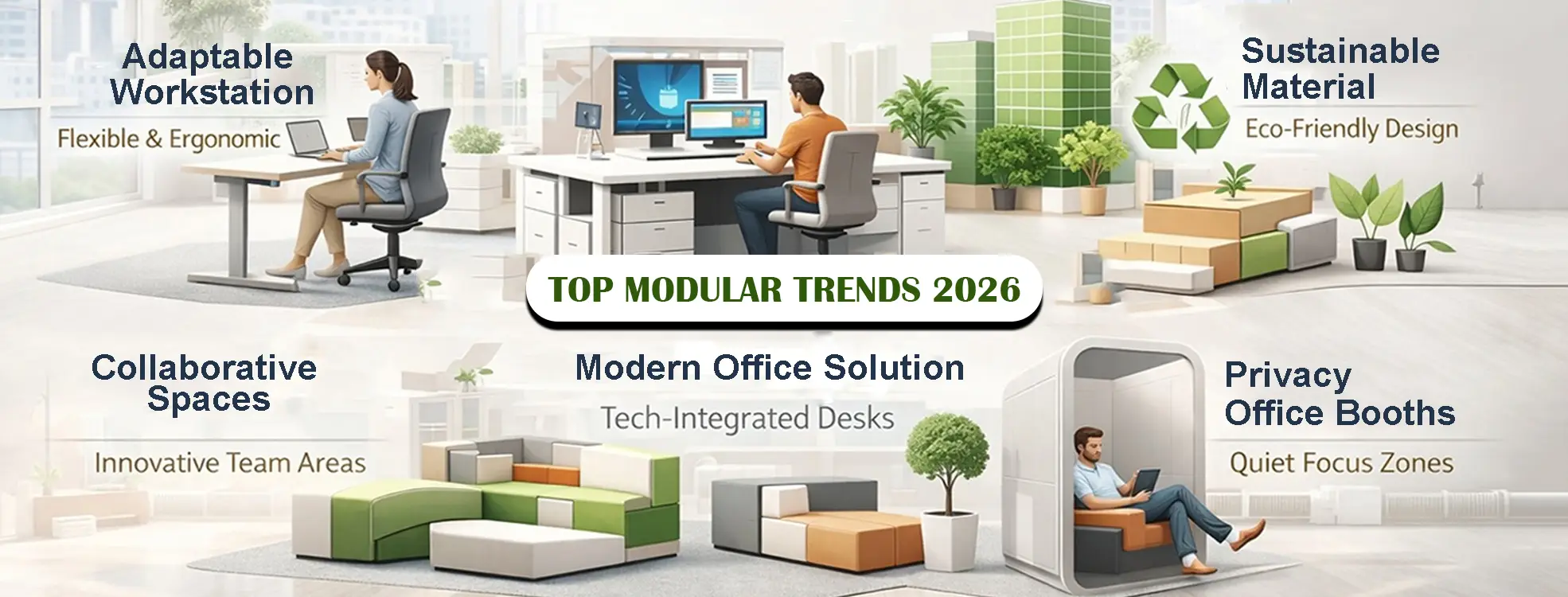
Top 5 Modular Office Furniture Trends 2026
1. Adaptable Workstations (Flexible & Ergonomic)
Trend Overview
Adaptable office workstations are leading the modular revolution in 2026. Designed for flexibility and ergonomics, these systems include height adjustable desks, movable panels, modular storage solutions, and reconfigurable layouts that can evolve without major renovations.
The focus is on creating work environments that support both collaboration and individual productivity while prioritizing employee comfort.
Market Demand & Target Audience Relevance
- Architects & Interior Designers: Greater layout flexibility and ergonomic integration
- PMC’s: Simplified reconfiguration and long-term scalability
- Corporates: Enhanced employee wellness, productivity, and optimized space utilization
Applications
Open-plan offices, hybrid workspaces, co-working hubs, and activity-based working zones.
How Businesses Can Adapt
Partner with experienced office furniture suppliers offering modular workstation systems that combine flexibility with ergonomic design standards.
If your focus is on workstation planning for your office, read our guide on Latest Key Trends in Modular Workstation Designs
2. Sustainable Materials (Eco-Friendly Design)
Trend Overview
Sustainability has become a core decision-making factor in office design. Modular office furniture made from recycled materials, responsibly sourced wood, low-VOC finishes, and recyclable components is dominating workspace trends in 2026.
Market Demand & Target Audience Relevance
-
Corporates: Alignment with ESG goals and sustainability commitments
-
PMC’s: Compliance with green building certifications (LEED, IGBC)
-
Designers: Blending aesthetics with environmental responsibility
Applications
Green-certified offices, sustainable campuses, corporate headquarters, and environmentally conscious startups.
How Businesses Can Adapt
Collaborate with modular office furniture manufacturers that provide certified sustainable product lines and transparent sourcing practices.
3. Modern Office Solutions (Tech-Integrated Desks)
Trend Overview
Modern office furniture is transforming how employees interact with their workspace. Tech-integrated desks featuring built-in power modules, USB ports, wireless charging, cable management systems, and IoT-enabled features are becoming the new standard.
These Modern solutions enhance productivity while maintaining a clean, clutter-free aesthetic.
Market Demand & Target Audience Relevance
-
Architects: Seamless integration of technology into workspace design
-
Corporates: Increased efficiency and reduced infrastructure complexity
-
Interior Designers: Sleek, modern, tech-enabled environments
Applications
Corporate offices, conference rooms, innovation labs, executive cabins, and agile workstations.
How Businesses Can Adapt
Choose an office furniture supplier with in-house manufacturing and Modern furniture capabilities to future-ready workspaces.
For insights on improving workspace efficiency, see our blog on How Modern Office Furniture Improves Workspace Efficiency
4. Collaborative Spaces – Innovative Team Areas
Trend Overview
Modern workplaces are placing greater emphasis on collaboration and idea-sharing. Modular furniture designed for team engagement — such as movable partitions, flexible meeting pods, modular lounge seating, and multi-functional tables — supports dynamic teamwork.
These spaces encourage creativity, communication, and cross-functional collaboration.
Market Demand & Target Audience Relevance
-
Architects & Designers: Flexible spatial planning solutions
-
Corporates: Enhanced teamwork and innovation culture
-
PMC’s: Efficient use of floor space with adaptable layouts
Applications
Brainstorming zones, informal meeting spaces, training rooms, breakout areas, and collaborative hubs.
How Businesses Can Adapt
Engage with forward-thinking office furniture suppliers offering customizable collaborative systems tailored to organizational workflows and culture.
Learn from our guide on How to Plan and Organize Your Office Space with Modular Furniture for optimal collaborative layouts.
5. Modular Privacy Pods – Quiet Focus Zones
Trend Overview
As open offices continue to dominate, the demand for privacy and focused work areas has grown significantly. Office Phone Booths provide sound-insulated, compact, and flexible solutions for concentration, virtual meetings, and confidential discussions.
These quiet zones balance collaboration with focused productivity.
Market Demand & Target Audience Relevance
-
Corporates: Improved employee focus and reduced workplace distractions
-
Designers: Balanced open-plan layouts with acoustic solutions
-
PMC’s: Easy-to-install, scalable privacy solutions
Applications
Call booths, quiet pods, focus rooms, wellness rooms, and executive discussion spaces.
How Businesses Can Adapt
Work with modular office furniture manufacturers that offer acoustic-tested, customizable privacy pods compatible with evolving office layouts.
For detailed guide of ergonomics in Modular furniture, check out our blog on Role of Ergonomics in Office Furniture Design
Conclusion
The Top Modular Office Furniture Trends 2026 highlight a clear shift toward adaptable, sustainable, technology-integrated, and people-centric office environments. From flexible ergonomic workstations to smart desks, collaborative hubs, and privacy pods, modular solutions are reshaping how modern offices function.
By partnering with reliable office furniture suppliers and innovative manufacturers, organizations can create agile workspaces that support productivity, sustainability, and long-term growth.
Whether you are an architect, PMC, corporate decision-maker, or interior designer, embracing these trends will help you deliver future-ready, high-performance office environments with confidence.
FAQs
Q.1 – What are the benefits of using modular office furniture?
Ans. Modular office furniture offers flexibility, scalability, cost-efficiency, and ease of reconfiguration, making it ideal for evolving workplace needs.
Q.2 – How can modular furniture improve workspace flexibility?
Ans. Its reconfigurable nature allows teams to adapt layouts quickly for collaboration, privacy, or expansion without major renovations.
Q.3 – What should I consider when choosing an office furniture supplier?
Ans. Look for design expertise, manufacturing capability, sustainability credentials, customization options, and strong after-sales support.
See our guide on How to Choose Modern Office Furniture for Your Workplace
Q.4 – Are there sustainable options available in modular office furniture?
Ans. Yes, many office furniture manufacturers now offer eco-friendly modular solutions using recycled materials and sustainable processes.
Q.5 – How do I plan a modular workspace layout effectively?
Ans. Collaborate with architects, interior designers, and experienced office furniture suppliers to align layout planning with workflow, technology, and future growth.
Q.6 – How do adaptable workstations improve employee productivity?
Ans. They provide ergonomic comfort and flexible configurations, allowing employees to work efficiently in both collaborative and focused settings.
Q.7 – Are sustainable materials widely available in modular furniture?
Ans. Yes, Many office furniture manufacturers now provide eco-friendly solutions using recycled materials and sustainable production methods.
Q.8 – What are smart office desks?
Smart desks are technology-integrated workstations with built-in power access, charging ports, cable management, and IoT-enabled features.
Q.9 – Why are modular privacy pods important in modern offices?
Ans. They create quiet, distraction-free zones within open-plan layouts, supporting focused work and confidential communication.
Call to Action
Ready to transform your workspace for 2026 and beyond? Connect with leading modular office furniture suppliers today for expert consultations, customized modular solutions, and innovative designs that align with the latest workspace design trends. Explore future-ready modular office furniture and bring your next project to life.